The Fed is Dead To Me: Why I Quit Watching WWE
I grew up on wrestling.
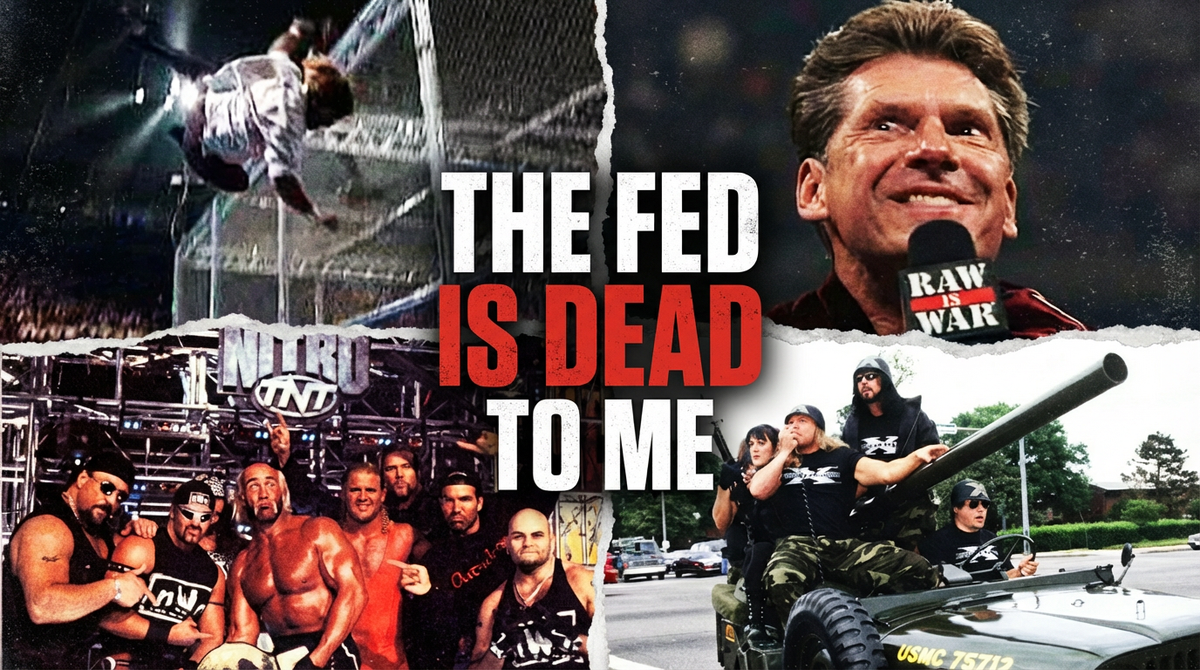
Specifically, the Attitude and nWo eras. Sting descending from the rafters. Hogan as the third man. Stone Cold beer baths. Goldberg’s streak. The DX invasion. I remember watching Mankind get thrown off the cage at King of the Ring ‘98. DDP and Karl Malone (yeah, I know). The Rock. The Dudleys vs Hardys vs Edge and Christian. Wrestling felt dangerous, anarchic, and alive. It felt like ours.
I watched religiously from about 1997 to 2004. Once the WWF bought WCW and ECW, things changed quickly. The Invasion angle was less a celebration of wrestling history and more like Vince McMahon dancing on the graves of two promotions he’d just purchased. After that, the PG-era writing finished the job. Everything felt overly polished, deeply cynical, and creatively bankrupt. The aura was gone.
So I walked away for almost a decade. I’d peek in occasionally, TNA grabbed my interest for a bit, but mostly I stayed out. Wrestling didn’t feel rebellious anymore. It felt corporate.
I came back around 2014. Brock Lesnar squashing John Cena at SummerSlam snapped my head around. So did what was happening outside the WWE bubble, indie wrestlers doing insane things in ROH, and New Japan at the time was putting on some of the best matches I’d ever seen. From 2014 to 2018, I hovered. WWE was still the only true mainstream option, and despite wildly inconsistent writing, talent like The Shield, Shinsuke Nakamura, Kevin Steen/Owens, AJ Styles, The New Day, and Finn Bálor kept my interest.
Then my relationship with World Wrestling Entertainment changed permanently.
Not because of booking.
Because of ethics.
In 2018, WWE announced its first major show in Saudi Arabia. I remember feeling conflicted in a way I hadn’t before. I loved wrestling. I loved the talent. But how could a company built on rebellion, defiance, and anti-authority openly partner with an authoritarian regime? How could something that once felt counter-culture align itself so comfortably with power?
At the time, I told myself it was just business. I told myself the talent mattered more than the deal. I was naïve as hell.
Then the news just kept getting worse.
After the death of former WWE wrestler Ashley Massaro, a sworn affidavit became public in which she alleged she was raped during a 2006 WWE military tour in Kuwait, and that WWE leadership discouraged her from reporting it so it wouldn’t jeopardize their relationship with the U.S. military. This wasn’t internet rumor or wrestling-forum speculation. There is a paper trail. It was reported by outlets like NPR.
That was the moment the fog lifted.
The Saudi deal wasn’t an outlier. It was a warning sign.
Then the dam broke. The Wall Street Journal reporting on Vince McMahon’s sexual misconduct, hush-money payments, and abuse allegations confirmed what had long been dismissed as dirt-sheet chatter. WWE wasn’t just a ruthless, capitalist wrestling company. It was a culture built to protect power, silence victims, and keep the machine running at all costs.
Even when WWE was “sold,” Vince never really left. He just changed seats. Under TKO Group Holdings, the company feels less like a wrestling promotion and more like a clout-chasing content farm, one that openly courts power, influence, and profit while pretending nothing fundamental has changed.
That shift is embodied perfectly by Triple H.
This is the same guy who once played the face of rebellion, the anti-authority figure who smashed thrones and mocked the machine. Now he spends more time smiling through photo ops with Donald Trump than standing up for the business he claims to protect. The transformation isn’t subtle. It’s symbolic. And it tells you exactly which side of power he’s chosen.
It doesn’t help that for years there have been repeated reports from wrestlers, journalists, and insiders about Triple H burying talent of color, sidelining performers who didn’t fit his vision of what a “top guy” looked like, and reinforcing the same old McMahon hierarchies under the guise of “what’s best for business.” Maybe some of that is politics. Maybe some of it is perception. But when the same stories keep surfacing across eras, you don’t get to wave them away as coincidence.
And listen, I don’t expect my entertainers to be morally perfect. Wrestling has always been messy. The people involved are flawed. That’s part of the appeal. But I do have a line. It moves over time, sure, but it exists.
I just prefer my entertainment not be openly aligned with sexual assault apologists, authoritarian regimes, or movements actively rooting for the erosion of American society. That shouldn’t be a radical standard. And yet, here we are.
Under TKO, WWE seems increasingly comfortable trading wrestling for spectacle, celebrity stunt casting, and algorithm bait. For every world-class performer on that roster, and there are many, there’s a Jake Paul appearance reminding you exactly what the priority is.
To be clear, I support wrestlers. I support workers getting paid. I support competition. Talent chasing opportunity and leveraging their worth is good for the business. It’s how wrestling stays healthy.
And WWE does need to exist. A strong, mainstream company lifts the entire industry. It creates scale, visibility, and opportunity that smaller promotions simply can’t provide on their own.
But that only works if the biggest company in wrestling remembers its responsibility to the business, not just its shareholders. If WWE keeps sliding further into cynicism, clout chasing, and moral rot, it won’t just hollow itself out. It will poison the ecosystem around it.
That’s why, for me, there’s no joy in watching WWE anymore, not because wrestling is fake, but because what the company stands for feels uncomfortably real.
I hope that changes someday. For the 13-year-old kid inside me who lived for stunners, suck its, and the Monday Night Wards. But for now, I’ll keep my attention where wrestling still feels alive, in places like All Elite Wrestling, New Japan, and the indies that keep the real heartbeat of professional wrestling loud, weird, and human.
Because wrestling should punch up. Not sell out.
And when it stops doing that, I stop watching.